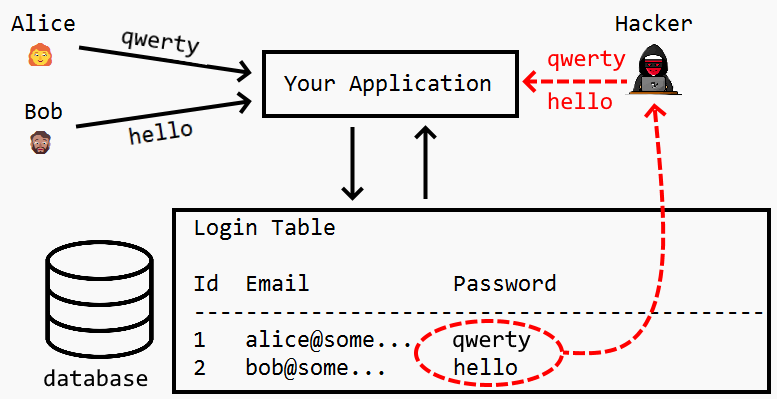
Hashing = scrambling passwords so NO ONE can read them! 🔒
Hashing is one-way only - you can’t reverse it
Same password = same hash every time
Even the website owner can’t see your real password!
This protects you if hackers steal the database
Background Information
When you create an account on a website, you choose a password. But did you know that good websites never store your actual password?
Instead, they use a special mathematical process called hashing to scramble it into a unique code. This code: - Always looks like random letters and numbers - Can’t be reversed back to your password - Changes completely if even one character in your password changes
Why is this important?
Imagine a hacker breaks into a website’s database: - Bad website (stores passwords): Hacker sees “password123” and can log into your account! - Good website (stores hashes): Hacker sees “ef92b778bafe771e89245b89ecbc08a44a4e166c06659911881f383d4473e94f” - useless to them!
How does login still work?
When you log in, the website: 1. Takes your password 2. Hashes it the same way 3. Compares the hash to the one they stored 4. If they match - you’re in! ✅
Practical Activity: Password Hashing Detective 🔍
Objective
Explore how password hashing works using Python and discover why it’s a one-way process.
You will need
A computer with Python installed
The Python code below
Paper and pen to record your findings
Step 1: Set up your password hasher
Run this Python code to create your password hashing tool:
Code
import hashlibdef hash_password(password):"""Hash a password using SHA-256"""# Convert password to bytes and hash it hashed = hashlib.sha256(password.encode()).hexdigest()return hashed# Test it out!test_password ="dragon"hashed_result = hash_password(test_password)print(f"Password: {test_password}")print(f"Hash: {hashed_result}")print(f"\nHash length: {len(hashed_result)} characters")
Now try to answer these investigation questions by experimenting:
Code
# Investigation 1: What happens with very similar passwords?print("INVESTIGATION 1: Tiny changes = huge differences")print("="*80)similar_passwords = ["cat", "Cat", "cats", "cat1"]for pwd in similar_passwords: hashed = hash_password(pwd)print(f"{pwd:10} → {hashed}")print("\nNotice: Even changing ONE character completely changes the hash!")
INVESTIGATION 1: Tiny changes = huge differences
================================================================================
cat        → 77af778b51abd4a3c51c5ddd97204a9c3ae614ebccb75a606c3b6865aed6744e
Cat        → 48735c4fae42d1501164976afec76730b9e5fe467f680bdd8daff4bb77674045
cats       → d936608baaacc6b762c14b0c356026fba3b84e77d5b22e86f2fc29d3da09c675
cat1       → 081706ccee3f19f01752ba7b60dec0f901a746fe4e3f8c00b70ee6671669c802

Notice: Even changing ONE character completely changes the hash!
Code
# Investigation 2: Is it consistent?print("\nINVESTIGATION 2: Same password = same hash?")print("="*80)password ="elephant"print(f"Hashing '{password}' five times:\n")for i inrange(1, 6): hashed = hash_password(password)print(f" {i}. {hashed}")print("\nNotice: The same password ALWAYS produces the same hash!")
INVESTIGATION 2: Same password = same hash?
================================================================================
Hashing 'elephant' five times:

  1. cd08c4c4316df20d9c30450fe776dcde4810029e641cde526c5bbffec1f770a3
  2. cd08c4c4316df20d9c30450fe776dcde4810029e641cde526c5bbffec1f770a3
  3. cd08c4c4316df20d9c30450fe776dcde4810029e641cde526c5bbffec1f770a3
  4. cd08c4c4316df20d9c30450fe776dcde4810029e641cde526c5bbffec1f770a3
  5. cd08c4c4316df20d9c30450fe776dcde4810029e641cde526c5bbffec1f770a3

Notice: The same password ALWAYS produces the same hash!
Code
# Investigation 3: Can we reverse it?print("\nINVESTIGATION 3: Can we go backwards?")print("="*80)original ="secret"hashed = hash_password(original)print(f"Original password: {original}")print(f"Hashed version: {hashed}")print(f"\n❌ There is NO way to reverse this hash back to '{original}'")print(" Even the website owner cannot see your original password!")
INVESTIGATION 3: Can we go backwards?
================================================================================
Original password: secret
Hashed version:    2bb80d537b1da3e38bd30361aa855686bde0eacd7162fef6a25fe97bf527a25b

❌ There is NO way to reverse this hash back to 'secret'
   Even the website owner cannot see your original password!
Step 4: Test your own passwords!
Important Safety Note: Don’t use your real passwords for practice! Make up fake ones instead.
Code
# Try your own passwords (use FAKE passwords only!)print("HASH YOUR OWN PASSWORDS")print("="*80)# Replace these with your own test passwordsmy_passwords = ["your_test_password_1","your_test_password_2","your_test_password_3"]for pwd in my_passwords: hashed = hash_password(pwd)print(f"{pwd:25} → {hashed}")
Discussion Questions
After completing the investigations, discuss these questions:
One-way process: Why is it impossible to reverse a hash back to the original password?
Security: If hackers steal a database of hashed passwords, why can’t they use them to log in?
Consistency: Why is it important that the same password always produces the same hash?
Small changes: What did you notice when you changed just one character in a password? Why is this important?
Real world: Can you think of other situations where one-way hashing might be useful?
Key Takeaways
✅ Hashing is one-way - You can’t reverse it
✅ Consistency matters - Same input = same output (every time)
✅ Tiny changes = huge differences - Changing one character completely changes the hash
✅ Protects your privacy - Even website owners can’t see your real password
✅ Security through mathematics - Hashing uses complex math that’s easy one way, impossible the other
Optional Stretch Activities 🌟
Challenge 1: Password strength explorer
Hash passwords of different lengths. Does a longer password create a longer hash?
Challenge 2: Hash comparison
If someone gives you a hash, can you figure out what their password was by trying common passwords? (This is called a “brute force attack”)
Challenge 3: Encryption vs Hashing
Compare hashing to the encryption lesson you learned earlier: - Which one can be reversed? - When would you use each one? - Why are both important for security?
Challenge 4: Research task
Look up “salt” in password hashing. Why do security experts add salt to passwords before hashing them?